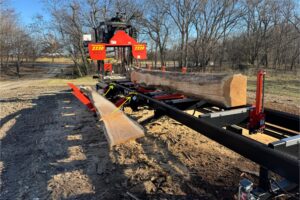
There is definitely a certain satisfaction from milling trees from fence rows. In this case, this large walnut tree had 3 barb wires going through it, that we could see.
Obviously, there was more than that, and with all the years of this old tree growing, the wire was twisted around inside, in many different directions.


If my sawmill blades could talk, they’d tell you all about this barb wire walnut tree. The good thing is, this old large walnut has beautiful grain and color to it, once you get past the barb wire. Notice the black streaks the barb wires leaves? Nails and screws do this as well.
Once I started hitting wire, I decided right away that it was going to be every single pass, so I kept cutting until my blade would start diving or dipping. No sense in trashing blades until needed.
The large 1-1/2” wide and .050 thick, 14’ 10-1/2” long blades I use aren’t cheap, so run them until they stop cutting flat cuts.
I chose to stop cutting this large walnut once I got down to a cant that was about 21” x 21”, and allowed it to sit and dry out, along with some of the large thick slabs I pulled off. Today, I decided to finish this ole aged walnut, barb wire and all.


These pictures will show how the barb wire affected by blade, by the chatter marks it left in each cut. It’s all part of milling logs, and when trees come out of fence rows, and back yards, this is to be expected!

If only trees could talk, just think of the stories they could tell us. 😂
Always do your best,
-Mike and Rhonda Pilcher

.
.