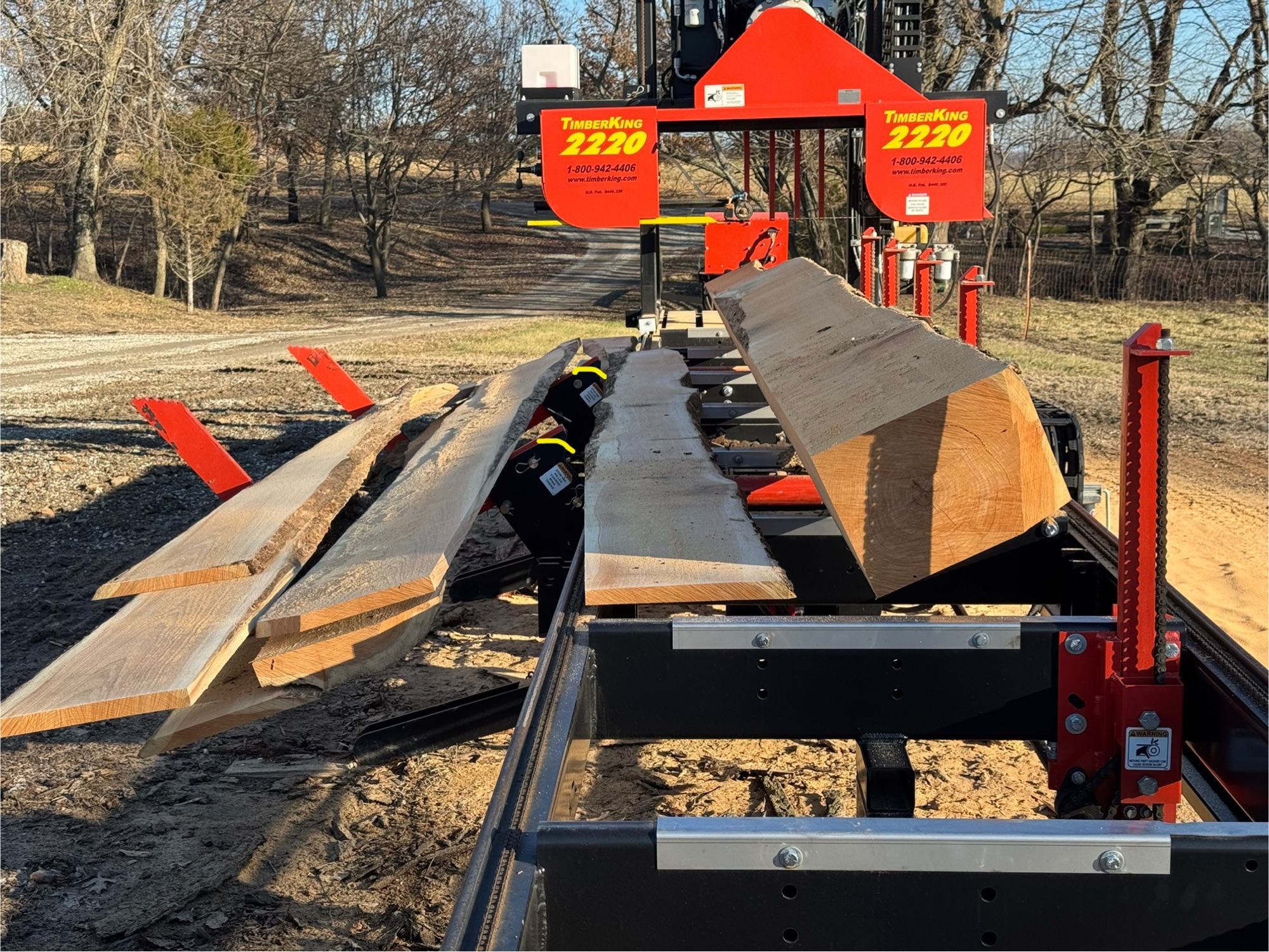
Are you wondering why your TimberKing sawmill is producing wavy lumber? And honestly, this goes for most any sawmill/bandmill as well.
Improper Bed or Guide Roller Alignment
If your sawmill bed isn’t leveled properly, or the guide rollers are misaligned, your saw blade will not cut parallel with the frame. It’s always a good idea to use long 4’ up to 8’ levels for getting your sawmill bed/frame perfectly level. I also like to use a string line to make sure I’m not low or high in places that the levels may not show. Laser levels also work very well! Check your guide roller deflection, which is how much the guide roller is pushing downwards in the guide rollers…(down pressure). I believe in running the thickest, widest blades my sawmill will accommodate. Mine are 1-1/2” wide and .055 thick and 7 degree pitch, using double spring set up with 1500# on blade tension. With these blades I like 1/4” deflection (down pressure). For me, this has helped produce much better and flatter lumber. Here is another YouTube video from a southern sawyer and lots of good tips, on how to achieve perfect cuts with your TimberKing sawmill, in which this post has covered most all of them.
I’ve seen and heard of many sawmills/bandmills that are set up perfectly, from leveled, perfectly sharpened blades, guide rollers and blade alignment is absolutely perfect, but only cut flat lumber in certain places on the sawmill deck. Long metal straight edges, string line and laser levels show gaps and unevenness of the frame are apparent. This is always an issue with the frame and deck, and not the setup. Maybe the jigs were off when welding everything together, or maybe jigs weren’t used? These are issues that you can continue to chase, but never catch them, or get them under control, no matter how much you try to block and level it out.
Incorrect Blade Tension and Drive Belt Tension
If your blade tension is too loose, it will make your blade deflect and create inconsistent thicknesses. Most TimberKing sawmills/bandmills recommend 1200# up to 1500# of blade tension. Never leave the blade tension turned up above 500# when sawmill is not in use, as it can cause wear and stress on tension springs, saw blades and also leave flat spots in wheel belts.
Now, believe it or not, drive belt tension can affect your sawmill/bandmill cuts as well. If the belt is slipping, even a little it can cause wavy lumber. When you start pushing your mill a lose belt, and even a belt that is to tight can cause issues, even more than wavy cuts. Here is a great YouTube video that shares in depth information about belt tension, and the importance of it.
Dull, Uneven or Bent Set Teeth
One of the most common problems that come from uneven cuts, is the saw blade is dull, or set teeth are uneven. This causes uneven cuts, diving and dipping while cutting, which creates wavy, inconsistent cuts in the lumber. If one side of blade cuts differently than the other side, then this causes wandering of the blade, while cutting, and makes for uneven and wavy cuts.
Stress and Log Movement
Another common issue is the logs. If you have cutting issues and have checked everything on your sawmill and it’s all good, then take a good look at your logs. Let’s say your logs came from a place where there were storms and high winds, or tornadoes, then these trees/logs probably have a good deal of stress inside of them. The wood can bow, pinch the blade and even push the cant off center. In this case, it’s a must to keep rotating your cant to get away from stress areas. It’s always good to try and keep the cant even with the center/pith, by taking cuts off of all sides to keep evened up. And sometimes the stress is to get in one direction, and you just have to stay away from the stress areas.
Keeping Saw Blades Clean Is Important
I’ve also found that keeping my sawmill blade/band clean has helped improve my cut quality a great deal. I have built blade wipers and guards under my guide rollers to keep band more stable, and the wiper keeps the blade clean and cool, with the right blade lubricants. When the blade and guide rollers are cleaned properly, then this also helps the life of the band blade wheel belts.
The Right Blade Lube For Your Sawmill
There are many opinions on the best blade lubricants, and all are not correct. Many sawmill/bandmill companies will tell you diesel fuel for blade lube will destroy your wheel belts and other parts, but this isn’t true, unless you are using gallons of diesel per hour. Drips are what is recommended for blade lube, no matter what lube you decide to use. I’ve developed an automated drip/lube system for my mill, which works flawlessly, and very efficiently as well. In other words, it uses 1/3 or less lube with this system, than without.


Diesel fuel for blade lube is great, but many folks don’t like the expense of diesel, or the smell of it. The best lube I’ve found besides diesel fuel is; Cotton Picker Spindle Cleaner. This oil based, water soluble lubricant is amazing…and cheap to use. It’s safe to the environment, to humans and to animals.


Many use water with dawn dish soap and or Pinesol, which is ok, but not the best for your sawmill. This causes rust on blade and guide rollers, as well as lots of sawdust and gunk build up inside your band wheel areas and all over the mill in general. I know, because I’ve used these, and do not recommend them.
Always do your best,
-Mike Pilcher
MPE LLC

.
.